Most businesses entered the AI race by experimenting with chatbots, automation tools, or isolated pilots. Few stopped to ask a bigger question. How does generative AI actually transform the business model itself?
In 2026, scattered adoption is not enough. Without a defined strategy, AI investments create fragmented tools, compliance risks, and rising costs instead of measurable value.
A Gartner report emphasizes the Global spending on generative AI will reach approximately $2.5 trillion by the end of 2026. Organizations that win are those that treat generative AI as a structured capability, aligning it with operations, data governance, and long-term growth objectives. Building a deliberate generative AI strategy is now critical to unlocking real returns rather than chasing trends.
Let’s decode how generative AI changes strategy by immersing deep into this blog:
What is a Generative AI Strategy?
A generative AI strategy primarily involves designing and implementing artificial intelligence systems. These inventive systems can generate new and unique outputs based on learned data. These strategies use complex algorithms to simulate creative processes. They adapt smartly to various environments and improve human capabilities across multiple domains. A well-devised generative AI strategy encourages businesses to automate tasks. It helps personalise user experiences and nurture innovation by creating novel content and solutions.
Examples of Generative AI Strategy
1. Business Alignment and Goal Setting:
2. Developing a Data and Analytics Roadmap:
Understanding the contemporary maturity of your data and analytics capabilities authorises the creation of a structured roadmap. This includes prioritising initiatives that leverage generative AI to reinforce data management processes or enhance decision-making powers.
3. Optimising Technical Infrastructure:
Building a robust and scalable tech environment that supports generative AI applications is essential. This may involve adopting cloud-native solutions and guaranteeing that the architecture can manage increased data loads without sacrificing performance.
4. Empowering the Workforce:
A strategic generative AI plan or strategy also entails defining roles and responsibilities and delivering training for adequate use of AI tools. It ensures that all personnel are equipped to utilise these technologies responsibly and impactfully.
What is a Generative AI Strategy Framework?
Top 7 Advantages of Generative AI Strategy for Businesses
Enforcing a generative AI strategy brings numerous benefits across various sectors. The perks range from enhancing customer experience to leveling up operational efficiencies. Here’s how businesses stand to gain from this advanced technology:
1. Increased Efficiency and Productivity
Generative AI automates routine tasks and streamlines workflows. It accelerates decision-making processes. This automation frees up employees to focus on more strategic activities. It eventually boosts productivity and reduces operational costs.
2. Enhanced Customer Experience
With the usage of generative AI, businesses can improve customer interactions through dynamic AI agents that provide personalized and sophisticated responses. This technology enriches customer service by supporting human agents. It promises more effective and engaging customer communication.
3. Innovation and Creativity
Generative AI is a pro at generating new and innovative ideas. It curates refined content and designs that can be pivotal for marketing, product development, and other creative domains. This capability helps businesses to continuously introduce fresh concepts and stay forward in the competitive landscape.
4. Scalability
With generative AI, businesses can level up their operations effortlessly without a significant increase in costs. This scalability is vital for addressing growing amounts of data and expanding service capacities without compromising quality or performance.
5. Improved Decision Making
Generative AI can skillfully analyze vast datasets to extract insights and forecast trends. These creative insights aid in more informed and strategic decision-making. This characteristic is particularly valuable in fields like finance and healthcare because in these sectors, precision and accuracy are of immense significance.
6. Tailored Business Solutions
The next generation of generative AI models is being developed and deployed to cater specifically to the needs of different industries. This specialization will encourage more precise applications by enhancing effectiveness and efficiency in various business operations.
7. Competitive Advantage
Businesses that execute generative AI can attain a significant edge over competitors by improving speed, innovation, and customer engagement. Plus, the ability to quickly adapt to market changes and consumer needs with the assistance of AI can lead to superior market positioning.
5 Pillars of a Powerful Generative AI Strategy
Curating a robust generative AI strategy needs a multi-dimensional approach. This approach should encompass strategic alignment, technological infrastructure, governance, team ability, and relentless improvement. Here are the five key pillars that form the foundation of a powerful generative AI strategy:
1. Strategic Alignment with Business Goals
Matching generative AI initiatives with business objectives is vital. It involves recognizing specific business areas where AI can add value. It includes setting strategic and operational goals that AI can help achieve. A powerful GenAI Strategy also encompasses integrating AI into broader business growth plans. It is important to ensure that AI investments are targeted to enhance operational efficiency. They should stimulate customer experience and reinforce innovation in business proceedings.
2. Gen AI Maturity Assessment & Roadmap Development
Developing a generative AI strategy starts with understanding the existing state of AI and data capabilities within the organization. It involves assessing the tools and technologies. It evaluates the skills available as well as the data infrastructure. With this in-depth examination, companies can create a structured roadmap by setting realistic targets and milestones for AI integration and maturity.
3. Technical Infrastructure Optimization
A scalable and modular technical infrastructure is important to support generative AI applications. It means creating a tech stack that can adapt and scale without incurring prohibitive costs. Optimizing infrastructure also involves using cloud-native solutions. It further ensures that the tech stack supports the agile integration of new AI tools as they become available.
4. Data Governance and Security
Robust data governance is essential when implementing generative AI to organize risks around data privacy, security, and ethical use of AI. Companies should establish clear data usage guidelines. They must set up oversight mechanisms and continuously monitor AI performance to guarantee compliance with legal and ethical standards.
5. Empowering and Educating the Workforce
For the successful inclusion and utilization of generative AI within an organization, employees must be equipped with vital skills and knowledge. It involves stating clear roles and responsibilities and providing ongoing training in AI and data literacy. It should eventually nurture a culture that encourages innovation and adaptability.
How to Build a Generative AI Strategy for Your Business?
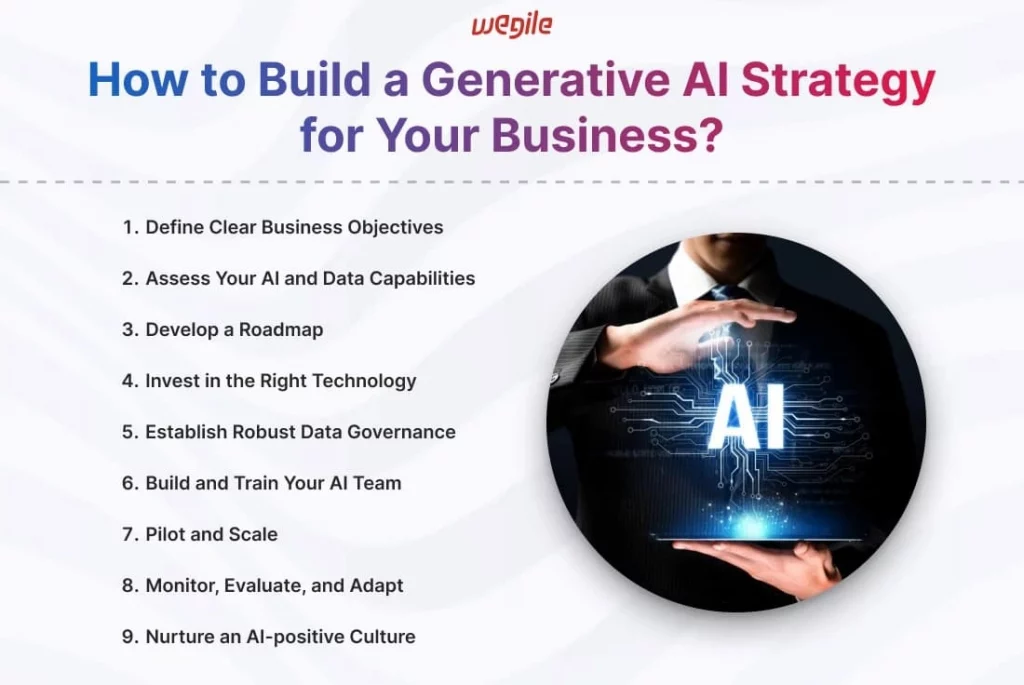
Crafting a generative AI strategy for your business involves careful planning and strategic execution to guarantee that AI initiatives match your company’s goals and bring meaningful outcomes. Here’s a comprehensive guide on how to develop a generative AI strategy:
1. Define Clear Business Objectives
Begin by identifying specific business problems that generative AI can solve. Set defined objectives such as improving customer service and enhancing product design. It also includes automating content creation and optimizing operational efficiencies. This synchronization makes sure that your generative AI investments are directed toward areas that present the most significant impact on your business performance.
2. Assess Your AI and Data Capabilities
Assess your current technology infrastructure and data availability. Also, evaluate the generative AI skills of your workforce. Understanding where you stand in terms of data maturity and technological readiness will help in setting realistic goals for AI implementation.
3. Develop a Roadmap
Create a strategic roadmap that summarizes the phased implementation of generative AI projects. It should include short-term wins and long-term objectives. Prioritize projects based on their potential influence and feasibility. The roadmap should also note the incorporation of generative AI into existing business processes to ensure seamless adoption.
4. Invest in the Right Technology
Select the appropriate generative AI tools and platforms that match your business needs. It may involve selecting between developing in-house solutions and buying commercial AI software. It also involves partnering with AI service providers. Make sure your technology stack is scalable, secure, and skilled in integrating new generative AI advancements as they emerge.
5. Establish Robust Data Governance
Set strict data governance protocols to manage data quality, privacy, and security. It is crucial to cut risks associated with the implementation of a generative AI strategy. These risks are bias, ethical issues, and compliance with regulations. Formulate guidelines for data usage and model training to retain transparency and reinforce accountability in generative AI operations.
6. Build and Train Your AI Team
Building a generative AI strategy needs specialized skills in machine learning, data science, and software engineering. Invest in training your current staff, and if necessary, you can hire new talent to fill skill gaps. Developing a collaborative environment where generative AI experts work alongside domain specialists can promote innovative solutions and encourage knowledge sharing.
7. Pilot and Scale
Begin with pilot projects to test the impact and quality of generative AI solutions in real-world scenarios. Utilize the insights gained from these pilots to refine your approach and scale successful applications across the organization. Constantly monitor the performance of generative AI systems and make iterative modifications to enhance their accuracy and efficiency.
8. Monitor, Evaluate, and Adapt
Regularly check the performance of your generative AI initiatives against set KPIs and adjust your strategy as needed. It includes adapting to technological changes and evolving market conditions. It also evaluates feedback from AI users within the organization. An agile approach allows your business to stay highly competitive and maximizes the ROI from AI investments.
9. Nurture an AI-positive Culture
Facilitate an organizational culture that welcomes innovation and change. Motivate employees at all levels to engage with generative AI technologies and comprehend their potential benefits and limitations. An informed and supportive workforce can enormously enrich the success of your generative AI strategy.
Conclusion
Understanding and deploying a generative AI strategy is a key factor in staying ahead in the business realm. This strategy goes beyond mere technology implementation as it aids in revolutionizing how organizations operate, innovate, and interact with their customers. By integrating Generative AI strategies, companies are not just automating tasks; they are nurturing environments where creativity flourishes. It promotes an area where decisions are enhanced and personalized customer experiences are the norm.
If your business is looking to not only keep up but stay ahead of the curve, then partner with Wegile. We can help tailor a generative AI strategy that aligns with your unique business needs that drive not just growth but real change across your operations. Explore how Wegile’s Generative AI App Development Services can move your business into the future. Immerse into a new era of business with confidence and the power of AI.
Leave a Reply